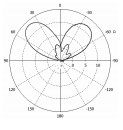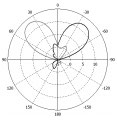

Just as a glass magnifying lens focuses light, an RF lens focuses radio frequency waves traveling through it into a point on the other side. When such a lens is placed in front of radiating structure – such as an antenna – the transmitted and received RF signals are also focused. This can result in improved RF link budgets, longer range, or more focused sectors. That’s the basic idea behind lens antennas.
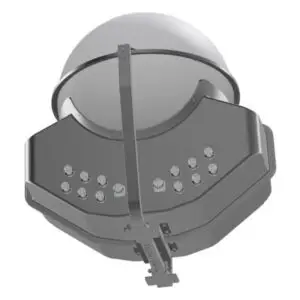
RF lenses are made with specialty dielectric materials that refract RF waves, similar to optical lenses which use glass to refract light. But these RF lenses are more than just a simple magnifying lens – it’s a special type of RF lens known as a Luneburg lens, which enables highly efficient multi-beam, multi-sector operation to improve coverage and capacity.
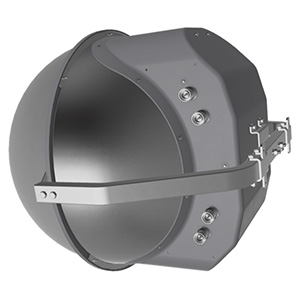
The Luneburg lens
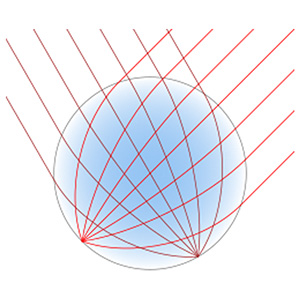
Invented in 1944 by Rudolf Luneburg, this unique lens design has the special property that it focuses radio waves regardless of which direction the signal is coming from, due to its spherical shape. A standard convex magnifying glass only focuses properly when viewed boresight, on-axis – when viewed off-center, the image is distorted. However, the view through a glass marble, a simple type of spherical lens, stays the same regardless of direction. In mobile networks this means that multiple beams, or sectors, can be served by a single lens.
To achieve the Luneburg lensing effect, the lens is constructed from dielectric materials of varying permittivity’s, typically 2 at the center of the lens and 1 at the edge. This creates a gradient index of refraction which smoothly bends and focuses the radio waves as they pass through the lens.
Implementing this effect on antennas allows for some improvements in a whole array of applications
Sector splitting – small sectors, higher capacities
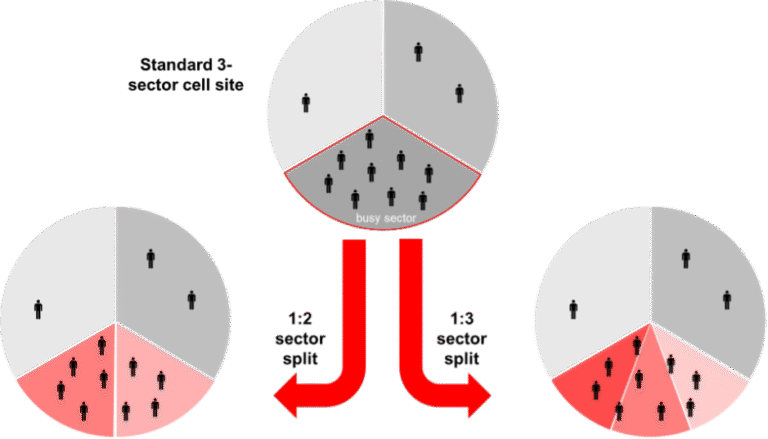
Dense urban environments, stadiums and event venues, and transportation corridors are typical locations where heavy mobile traffic and limitations on antenna placement dictate the need for optimized coverage and capacity techniques. Sector splitting is one such technique: instead of using a single 65° beam for a sector, multiple beams of 30°, 20°, 15° and so on can be used. The reduction in beamwidth allows multiple beams to cover the same area and boost throughput overall.
Traditional sector antennas are also capable of providing multiple beams, though with a significant trade-off of larger antenna sizes and reduced performance. Alternatively beam-forming and beam shaping techniques used by massive MIMO radios have a similar effect on coverage and capacity, but MIMO radios are not viable in the lower frequency bands. They also rely on power-intensive digital signal processing algorithms, while a lens is a simple passive element that doesn’t consume any power.
Luneburg lens antennas are a new tool for solving the perennial challenge of coverage and capacity constraints in mobile networks. Their performance shows excellent results in spatial efficiency, gain and coverage, and are an excellent fit for cell sites that serve many subscribers, experience congestion, or have coverage challenges.