Posted on

Lens Antennas: A New Category of Multi-Beam Base Station Antennas

The Luneburg lens

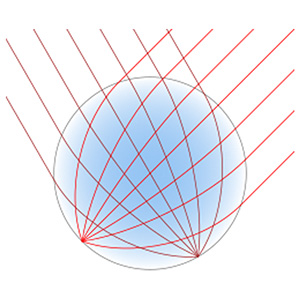
Just as a glass magnifying lens focuses light, an RF lens focuses radio frequency waves traveling through it into a point on the other side. When such a lens is placed in front of radiating structure – such as an antenna – the transmitted and received RF signals are also focused. This can result in improved RF link budgets, longer range, or more focused sectors. That’s the basic idea behind lens antennas.

RF lenses are made with specialty dielectric materials that refract RF waves, similar to optical lenses which use glass to refract light. But these RF lenses are more than just a simple magnifying lens – it’s a special type of RF lens known as a Luneburg lens, which enables highly efficient multi-beam, multi-sector operation to improve coverage and capacity.
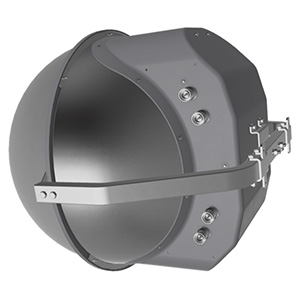
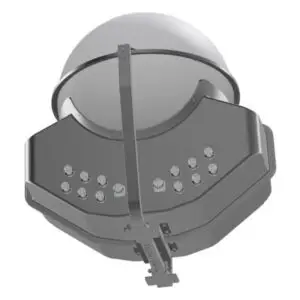
Dengyo lens antenna
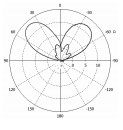
Lens antenna: two beams @ 15° beamwidth
a simple type of spherical lens
Spherical RF lens focuses the beams

The Luneburg lens

Invented in 1944 by Rudolf Luneburg, this unique lens design has the special property that it focuses radio waves regardless of which direction the signal is coming from, due to its spherical shape. A standard convex magnifying glass only focuses properly when viewed boresight, on-axis – when viewed off-center, the image is distorted. However, the view through a glass marble, a simple type of spherical lens, stays the same regardless of direction. In mobile networks this means that multiple beams, or sectors, can be served by a single lens.

To achieve the Luneburg lensing effect, the lens is constructed from dielectric materials of varying permittivity’s, typically 2 at the center of the lens and 1 at the edge. This creates a gradient index of refraction which smoothly bends and focuses the radio waves as they pass through the lens.

Implementing this effect on antennas allows for some improvements in a whole array of applications

Sector splitting – small sectors, higher capacities

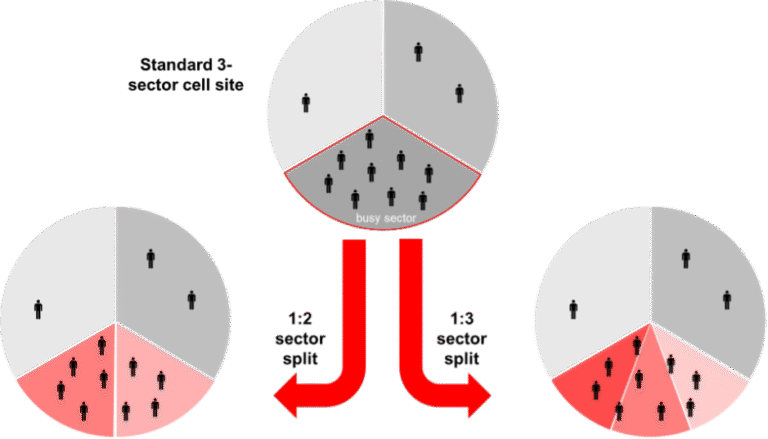
Dense urban environments, stadiums and event venues, and transportation corridors are typical locations where heavy mobile traffic and limitations on antenna placement dictate the need for optimized coverage and capacity techniques. Sector splitting is one such technique: instead of using a single 65° beam for a sector, multiple beams of 30°, 20°, 15° and so on can be used. The reduction in beamwidth allows multiple beams to cover the same area and boost throughput overall.

Traditional sector antennas are also capable of providing multiple beams, though with a significant trade-off of larger antenna sizes and reduced performance. Alternatively beam-forming and beam shaping techniques used by massive MIMO radios have a similar effect on coverage and capacity, but MIMO radios are not viable in the lower frequency bands. They also rely on power-intensive digital signal processing algorithms, while a lens is a simple passive element that doesn’t consume any power.

Luneburg lens antennas are a new tool for solving the perennial challenge of coverage and capacity constraints in mobile networks. Their performance shows excellent results in spatial efficiency, gain and coverage, and are an excellent fit for cell sites that serve many subscribers, experience congestion, or have coverage challenges.

 

Posted on

Sector-Splitting

Dengyo Sector-Splitting Luneburg

The Use of Sector-Splitting to Add Capacity in Dense Areas

Mobile network operators face constant pressure to increase 5G network coverage and capacity. There are different ways to achieve this, such as adding new cell sites or small cells, but the important question is not necessarily how, but what is the best way to accomplish this?Sector splitting is arguably the quickest and most cost-effective way to densify and add capacity to the mobile network. Just take an existing sector and split it into two, three or more sectors by adding radios and antennas.

New Multi-Beam antennas

Recently Dengyo launched its new line of Luneburg lens antennas, with multi-beam options. A multi-beam antenna splits a sector into 2, 3, or 4 sectors so that multiple antennas are not needed. Radios are then added to the new, smaller sectors to add capacity.


Avoid the costs of building a new site

Sector splitting is a far quicker and cost-effective option than adding a new site, whether the site is a macrocell, microcell, or picocell. Sector-splitting leverages the existing site infrastructure, so it avoids many costs associated with building a new site including:

  • • Site acquisition & permitting
  • • Construction & project management
  • • Site preparation and commissioning
  • • Operating costs including fiber fronthaul/backhaul, rent, and insurance

New Multi-Beam antennas

Recently Dengyo launched its new line of Luneburg lens antennas, with multi-beam options. A multi-beam antenna splits a sector into 2, 3, or 4 sectors so that multiple antennas are not needed. Radios are then added to the new, smaller sectors to add capacity.

Base Station Antennas- LENS SPHERE from Dengyo

Luneburg Lens Antenna

•  Splits one sector into multiple sectors with a varying beamwidth by frequency band.

•  High beam isolation to prevent interference

•  Excellent spectral efficiency

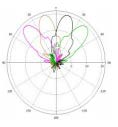
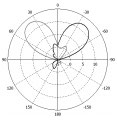
Horizontal Pattern
Radiation Pattern (1880-2025MHZ)

Sector splitting

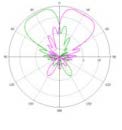
Horizontal Pattern

Horizontal Pattern
Radiation Pattern (1710-1830MHZ)

Horizontal Pattern
Radiation Pattern (885-960MHZ)

Radiation Pattern (703-798MHZ)

Dengyo Sector Splitting

For more information on Dengyo’s multi-sector lens antennas, please visit

Posted on Leave a comment

Designing the Future of Wireless Connectivity

Future of Wireless Connectivity

In a world running on instant connections—where AI drives autonomous cars, surgeons perform remote surgery, and data streams in real-time—the wireless infrastructure has to be an enabler.

For over seven decades, the team at DENGYO has been obsessively engineering antenna and base station solutions that do more than just send and receive RF signals; they are the reliable hardware that makes mobile connectivity possible.

Less Hardware, More Intelligence

We believe in minimalist performance. Our product portfolio is built for all RF environments: the packed city street, the sold-out stadium, and the factory floor or warehouse. Our hardware is designed to provide coverage and capacity.

Take, for example, our Luneburg lens antenna. The concept is a classic—first introduced in 1944—where a sphere of dielectric material can focus radio waves from any direction at once.

Instead of relying on power-hungry digital processors to steer beams, this passive lens is constructed with a dielectric gradient to naturally bend and concentrate RF waves. It’s an ultra-efficient workhorse that allows you to split sectors, boost capacity in crowded areas, and deliver multiple beams simultaneously—all without taking up precious cell tower space.

Full Portfolio of Antennas

DENGYO’s comprehensive portfolio includes base station antennas and specialty antennas for all environments, including:

  • • 2 – 12 port panel antennas
  • • Beamforming antennas, up to 28 ports or more
  • • Small Cell canister antennas for flag poles and light poles
  • • Tri-sector canister antennas
  • • Luneburg lens antennas spherical and cylindrical
  • • Antennas for Stadium and Venues
  • • In-building antennas for DAS systems

The NINJA: Invisible Power for Visible Impact

The NINJA Antenna Series was engineered to provide RF coverage while blending seamlessly into the background. It doesn’t look like an antenna at all—it looks sleek and transparent. With NINJA antennas, you no longer must choose between performance and aesthetics.

It’s not just about looking good; it’s about making installation easy in places that were previously impossible, all while delivering robust, responsive 5G service. For venue managers, city planners, and operators, the NINJA VLTA is the ultimate secret weapon: it keeps the signal strong and the sightlines clean, proving that the highest performing antennas don’t have to stand out to stand strong.

Looking Ahead

The demands on wireless are only going up. As AI deepens its role in everything from smart traffic systems to drone logistics, base station antennas must deliver higher throughput, enhanced coverage, and unwavering reliability across more frequency bands.

DENGYO’s solutions are already powering the most advanced Open RAN and 5G/6G deployments for leading operators and vendors worldwide. We take pride in building solutions that isn’t just engineered for the challenges of today’s networks—but built to support the intelligent, adaptive infrastructure of tomorrow.

To learn more, explore our project portfolio today.